
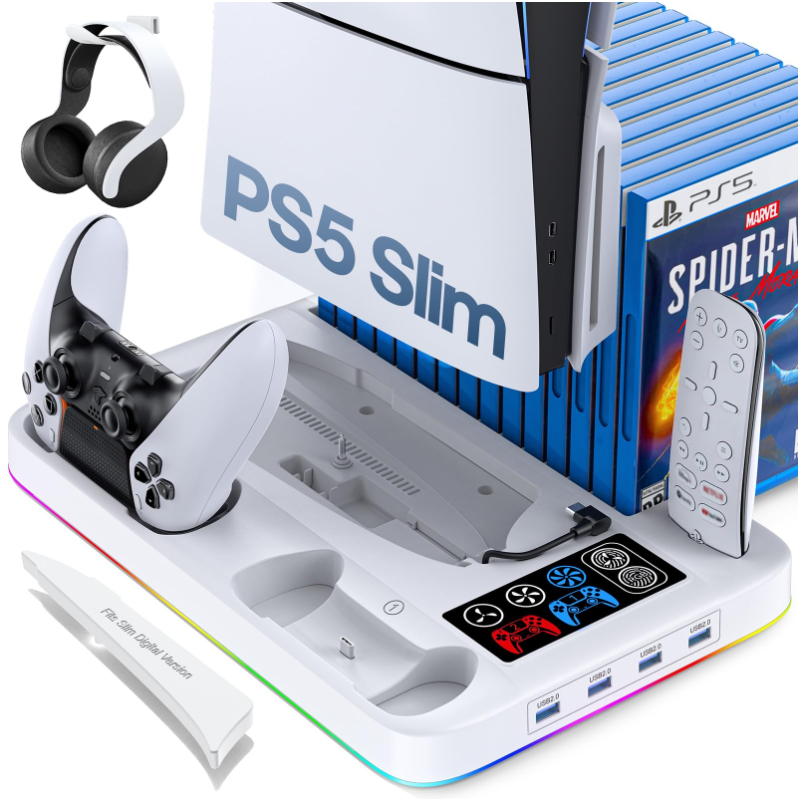
PS 5 COOLING FAN
| Category | Specification |
|---|---|
| Component | Internal cooling fan (PS5 / PS5 Slim) |
| Fan Size | 120mm diameter, 45mm thick |
| Design | Double-sided intake centrifugal fan |
| Blade Material | Glass fibre polybutylene terephthalate (heat-resistant) |
| Airflow | Draws air from both sides; exhausts through rear vents |
| Control | Software-optimized; tunable via online system updates |
| Thermal Interface | Liquid metal compound (~86% higher conductivity than standard paste) |
| Heatsink | Large copper plate + heat pipes (vapor-chamber-style performance) |
| Noise (later Slim revisions) | ~34.7 dB idle / ~38.2 dB under load |
| Slim/Pro Refinements | Revised liquid metal containment; updated heatsink materials |
| External Add-On Fans | Optional only — generally unnecessary; often noisy |
| Best Practice | Ensure adequate ventilation; avoid enclosed cabinets |
KSh 6,500.00
The PlayStation 5’s cooling system is one of the most critical and carefully engineered aspects of the console, designed to manage the substantial heat generated by its custom AMD processor while keeping noise levels low. Unlike a simple add-on accessory, the PS5’s thermal solution is a deeply integrated, multi-component system that combines a massive internal fan, an innovative liquid metal thermal interface, and a substantial heatsink. Understanding this system provides insight into why the console is as large as it is and how Sony has iterated on the design across different models, including the Slim revision.https://sammertechnology.co.ke/
The Heart of the System: The 120mm Double-Sided Intake Fan
The most visible component of the PS5’s cooling apparatus is its large internal fan. Official teardowns have revealed a 120mm-wide and 45mm-thick fan with a unique double-sided intake design . This is not a standard off-the-shelf PC fan; it is a custom centrifugal fan with sharp fins designed to pull air from both sides of the console and direct it through the chassis, with the entire rear of the unit devoted to heat exhaust .
Sony’s engineering team, led by Yasuhiro Ootori, explained that this large, single-fan design was chosen to cool both sides of the PS5’s mainboard equally. An alternative design using two smaller fans (one for each side) was considered, but this would have made the console larger . The fan blades are constructed from glass fibre polybutylene terephthalate, a material chosen for its strength and resistance to deformation under high temperatures, and it is reportedly quieter than the fans used in the PS3 and PS4 .
Crucially, the fan’s operation is not static. It is controlled by software that can be optimized through online updates. Sony stated that the console would collect data on how the APU behaves in different games and use that information to refine fan performance over time, potentially improving acoustics or cooling efficiency with future patches .
The Thermal Interface: Liquid Metal Innovation
While the fan moves air, the heat must first be efficiently transferred from the processor to the heatsink. The PS5 was the first mass-produced consumer device to use liquid metal thermal compound instead of traditional thermal paste . This was a significant engineering undertaking, reportedly taking Sony two years to develop .
Liquid metal offers a dramatic improvement in thermal conductivity—approximately 86% higher than standard paste—allowing the heatsink to absorb nearly 90% more heat from the system-on-chip (SoC) . This allows the processor to run cooler under demanding loads like 4K gaming. However, liquid metal is also electrically conductive and volatile; if it leaks, it can destroy components . This risk is why the compound cannot be easily reapplied by consumers without specialized tools, and why Sony has continually refined the containment system in later hardware revisions.
The Heatsink and Chassis Design
Complementing the fan and liquid metal is a massive heatsink. The original PS5’s heatsink features a large copper plate and copper heat pipes, positioned to mimic the performance of a vapor chamber cooler . This heatsink occupies a substantial portion of the console’s internal volume, which is a primary reason for the PS5’s large physical footprint.
The chassis itself is designed to facilitate airflow. The PS5 pulls air in from the sides and pushes it out the back, a different approach from the Xbox Series X, which pulls air from the bottom to the top . This design, combined with the double-sided fan, allows for effective cooling of the entire mainboard.
Evolution and Revisions: The PS5 Slim and Beyond
Sony has continuously refined the PS5’s cooling system with new hardware revisions. The PS5 Slim model, while smaller, introduced a revised cooling setup. Some user reports noted that the Slim’s fan could be audible under load, with some describing it as louder than the original model . However, later revisions (such as the CFI-2116 model) have shown significant improvements. Independent noise tests of this model recorded sound levels of just 34.7 dB at idle and 38.2 dB under heavy load, which is notably quiet .
These later Slim revisions also borrowed cooling technology from the high-end PS5 Pro. Teardowns revealed a revised liquid metal containment system where the protective barrier exposes less surface area to the liquid metal, better containing it and reducing the risk of leaks while keeping cooling closer to the processor . The heatsink construction and materials were also changed, further improving thermal efficiency . This ongoing refinement demonstrates that Sony has not treated the cooling system as a static design but as a component to be iterated upon for better performance, safety, and acoustics.
Add-On Cooling Fans: Necessity or Gimmick?
Given the PS5’s robust internal cooling, third-party external cooling fans are a common accessory but are generally unnecessary for a healthy console. These devices typically attach to the back of the console and plug into a USB port, using small fans to extract hot air . While some users report they help with overheating issues, the consensus from user reviews is often mixed. Common complaints include excessive noise and a feeling that they are a waste of money for a well-functioning console, as the PS5’s internal fan is already designed to handle the thermal load . For most users, ensuring proper ventilation around the console (keeping it out of enclosed cabinets) is far more effective than adding external fans.
Summary
The PS5’s cooling fan is part of an integrated thermal management system that includes a custom 120mm double-sided fan, a liquid metal thermal interface, and a large heatsink. This system is designed to handle the console’s heat output while maintaining low noise levels, and it has been progressively refined through hardware revisions, particularly in the PS5 Slim and Pro models. While external cooling fans exist, they are generally not required for normal operation and can introduce unwanted noise. The internal design, though complex and a factor in the console’s size, is a testament to Sony’s engineering focus on quiet, sustained performance.
Key Takeaways:
-
Internal Fan: 120mm double-sided intake, 45mm thick, software-optimized .
-
Thermal Interface: Liquid metal compound for 86% better conductivity than paste .
-
Heatsink: Large copper design mimicking vapor chamber performance .
-
Slim/Pro Revisions: Improved liquid metal containment and heatsink materials .
-
External Fans: Generally optional; can be noisy and are not a substitute for proper ventilation .
Based on 0 reviews
Be the first to review “PS 5 COOLING FAN” Cancel reply
Related products
-
GAMING ACCESSORIES
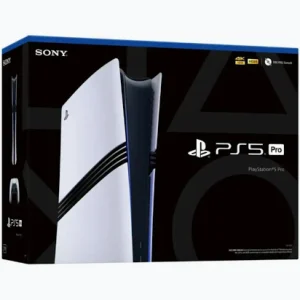
PS 5 PRO 2TB
0 out of 5(0)Core Hardware
-
Model Number: CFI-7021
-
Storage: 2TB Custom NVMe SSD
-
Optical Drive: Not included (Digital-only console; disc drive sold separately)
-
GPU: Upgraded AMD RDNA-based GPU (67% more Compute Units, 28% faster memory)
-
Key Technologies: PlayStation Spectral Super Resolution (PSSR) AI upscaling, Advanced Ray Tracing
Performance & Display
-
Target Performance: 60fps, or up to 120fps with 4K output and Ray Tracing (on compatible games)
-
Max Output: Supports 8K output via HDMI 2.1
-
Connectivity: Wi-Fi 7 compatible, Ethernet, Bluetooth
Physical & Box Contents
-
Dimensions: Approx. 388 x 89 x 216 mm (H x W x D)
-
Weight: Approx. 3.1 kg
-
In the Box: PS5 Pro Console, DualSense Wireless Controller, 2 Horizontal Stand Feet, HDMI Cable, AC Power Cord, USB Cable, ASTRO’s PLAYROOM (Pre-installed)
SKU: n/a -
-
GAMING ACCESSORIES
x box Series X
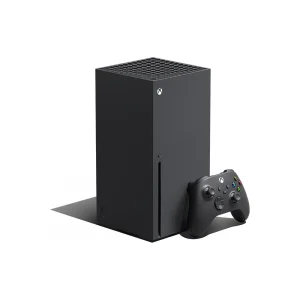
0 out of 5(0)Category Specification Model Xbox Series X (Flagship) Release Date November 10, 2020 Storage 1TB custom NVMe SSD (expandable via proprietary Storage Expansion Card) Optical Drive 4K UHD Blu-ray (standard model); All-Digital Edition also available CPU 8-core AMD Zen 2 @ 3.8 GHz (3.6 GHz with SMT) GPU Custom AMD RDNA 2, 12 TFLOPS, 52 CUs @ 1.825 GHz Memory 16GB GDDR6 (320-bit bus; 10GB @ 560 GB/s + 6GB @ 336 GB/s) Performance Target True 4K up to 120fps; 8K output supported Features Xbox Velocity Architecture, Quick Resume, DirectX Ray Tracing, Variable Rate Shading, Smart Delivery, Dolby Vision & Dolby Atmos Backward Compatibility Yes — thousands of games across four Xbox generations; FPS Boost & Auto HDR Ports HDMI 2.1, 3x USB 3.1 Gen 1, Ethernet, storage expansion slot Connectivity Wi-Fi 802.11ac (dual-band), Gigabit Ethernet Dimensions 15.1 x 15.1 x 30.1 cm Weight ~4.45 kg Colors Carbon Black (standard), Robot White (All-Digital), Galaxy Black (2TB Special Edition) In the Box Console, Xbox Wireless Controller, Ultra High Speed HDMI cable, power cable SKU: n/a -
GAMING ACCESSORIES
NINTENDO SWITCH 2 without mario kart
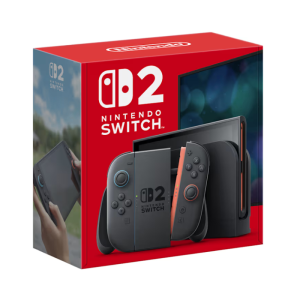
0 out of 5(0)ategory Specification Model Nintendo Switch 2 (hybrid console) Release Date June 5, 2025 Dimensions Approx. 116mm x 272mm x 13.9mm (with Joy-Con 2 attached) Weight Approx. 401g (tablet only); approx. 534g (with Joy-Con 2 attached) Display 7.9″ capacitive touchscreen LCD, 1920×1080, HDR10, VRR up to 120Hz CPU/GPU Custom NVIDIA processor Storage 256GB UFS (portion reserved for system) Storage Expansion microSD Express only (up to 2TB); requires system update TV Output Up to 3840×2160 (4K) @ 60fps; 120fps supported at 1080p/1440p; HDR10 Handheld Output Max 1920×1080 (matches screen resolution) Controllers Joy-Con 2 (magnetic attachment, mouse sensor, HD Rumble 2, larger analog sticks) Audio Stereo speakers; built-in monaural microphone with noise/echo cancellation; 3.5mm headphone jack Ports 2x USB-C (bottom for charging/dock, top for accessories/charging) Connectivity Wi-Fi 6, Bluetooth; wired LAN via dock Battery 5220mAh lithium-ion; approx. 2–6.5 hours playtime Charging Time Approx. 3 hours (in sleep mode) Backward Compatibility Supports both Switch 2 and original Switch game cards Dock Built-in cooling fan; 2x USB 2.0 ports, HDMI, LAN port Colors Standard black with colored Joy-Con 2 accents SKU: n/a -
GAMING ACCESSORIES
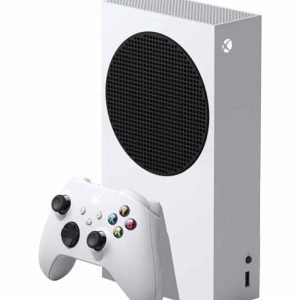
Xbox series s
0 out of 5(0)Category Specification Model Xbox Series S (All-Digital) Release November 10, 2020 Storage 512GB custom NVMe SSD (launch) / 1TB (Carbon Black edition) Storage Expansion Seagate Storage Expansion Card (proprietary); USB 3.1 external HDD for backward-compatible titles Optical Drive None (all-digital) CPU 8-core AMD Zen 2 @ 3.6 GHz (3.4 GHz with SMT) GPU Custom AMD RDNA 2, 4 TFLOPS, 20 CUs @ 1.565 GHz Memory 10GB GDDR6 (128-bit bus) Performance Target 1440p up to 120fps; 4K upscaling supported Features Xbox Velocity Architecture, Quick Resume, DirectX Ray Tracing, Variable Rate Shading, Spatial Audio (Dolby Atmos) Backward Compatibility Yes — thousands of games across four Xbox generations Ports HDMI 2.1, 3x USB 3.1 Gen 1, Ethernet, storage expansion slot Connectivity Wi-Fi 802.11ac (dual-band), Gigabit Ethernet Dimensions 6.5 x 15.1 x 27.5 cm Weight ~1.92 kg Colors Robot White (512GB), Carbon Black (1TB) In the Box Console, Xbox Wireless Controller, HDMI cable, power cable SKU: n/a
There are no reviews yet.