The Xbox Series S is Microsoft’s entry-level, all-digital gaming console, positioned as the smaller and more affordable sibling to the flagship Xbox Series X. Launched in November 2020, it was designed to deliver next-generation speed and performance—powered by the same custom SSD technology and architectural features as its larger counterpart—without the bulk or the price tag of a high-end machine. While it has undergone price fluctuations and a value reassessment over the years, the Series S remains the most accessible gateway into the Xbox ecosystem, particularly for players who prioritize digital convenience, fast loading times, and access to the vast Xbox Game Pass library over native 4K resolution or physical media.https://sammertechnology.co.ke/
Design and Form Factor
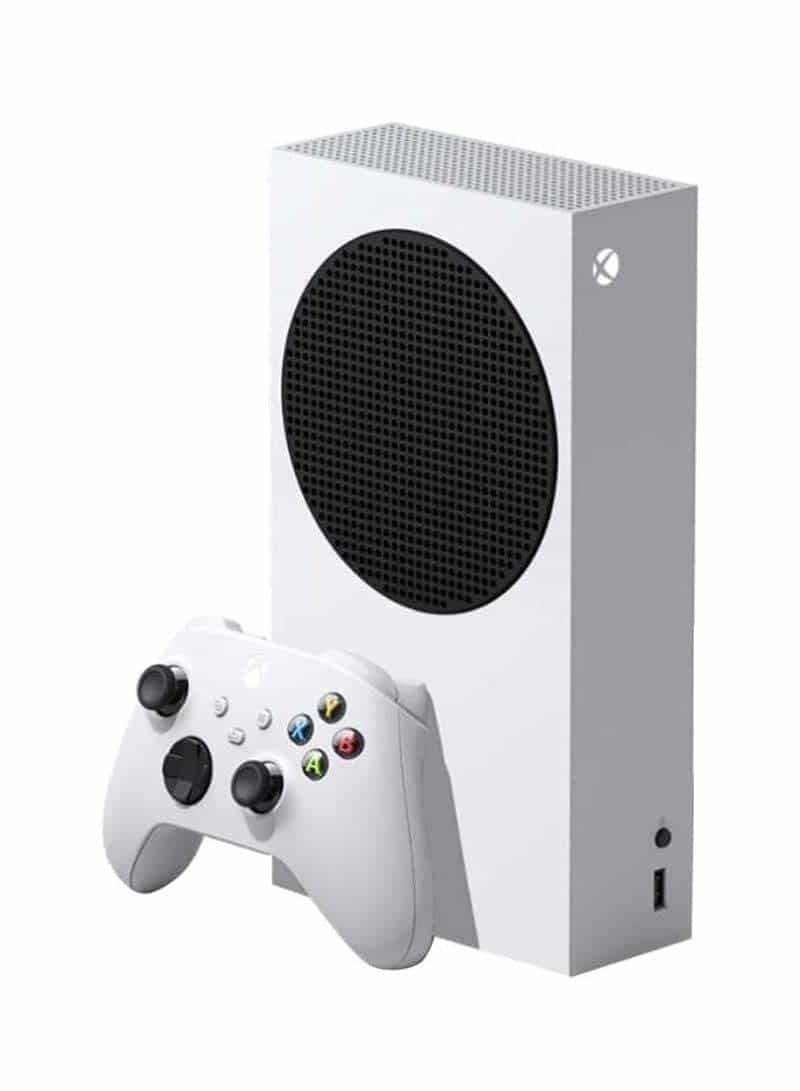
The Xbox Series S is remarkably compact, with a chassis that is roughly 60% smaller than the Xbox Series X . It measures just 6.5cm x 15.1cm x 27.5cm and weighs approximately 1.92 kg, making it unobtrusive enough to fit comfortably under a television, on a crowded desk, or in a backpack for travel . The console’s design is minimalist and functional, featuring a clean, boxy aesthetic with a prominent black circular vent on the top or side (depending on orientation), which serves as the primary exhaust for heat dissipation.
Unlike the Series X, the Series S is entirely digital, meaning it does not include an optical disc drive. This design choice is central to its identity: it is a console built for a library of downloaded games, streaming services, and cloud-based content. The console can be placed either horizontally or vertically, though a vertical stand is not required due to its flat base. The Series S originally launched in a “Robot White” finish, but Microsoft later introduced a Carbon Black version with an upgraded 1TB SSD, offering a sleeker, more understated alternative to the bright white original .
Hardware Specifications and Performance
At the heart of the Xbox Series S is a custom 8-core AMD Zen 2 CPU running at 3.6 GHz (or 3.4 GHz with simultaneous multithreading), paired with a custom RDNA 2 GPU delivering 4 TFLOPS of processing power . This is significantly less powerful than the 12 TFLOPS GPU found in the Series X, and the difference has real-world implications: while the Series X targets native 4K gaming, the Series S is designed primarily for 1440p resolution, with the ability to upscale to 4K for compatible televisions . In practice, the Series S generally hits its 1440p target at 60fps, though demanding titles may drop to 1080p, and it can support up to 120fps in games optimized for high frame rates .
The console is equipped with 10GB of GDDR6 memory on a 128-bit bus, a configuration that has occasionally proven challenging for developers pushing the boundaries of current-gen visuals . The most notable public example of this limitation came with Baldur’s Gate 3: Larian Studios initially could not achieve feature parity between the Series X and Series S versions, resulting in the Series S version shipping without local co-op—a compromise that highlighted the technical ceiling of the budget console .
However, the Series S shares the same Xbox Velocity Architecture as the Series X, which means it benefits from the same ultra-fast custom NVMe SSD and the associated quality-of-life features. Load times are dramatically reduced compared to previous generations, and the Quick Resume feature allows players to suspend multiple games and jump between them almost instantaneously, resuming exactly where they left off . This is arguably the console’s most compelling technical feature, making it feel genuinely “next-gen” despite its lower raw power.
Storage Options and Expandability
The Xbox Series S originally shipped with a 512GB custom NVMe SSD, but a significant portion of this capacity is reserved for system software. Users have reported that only around 364GB is actually available for game installations, a figure that fills up alarmingly fast with modern AAA titles that can exceed 100GB each . This storage limitation was a common criticism of the launch model.
Microsoft addressed this with the release of a 1TB Carbon Black edition, which doubles the internal storage and provides much more breathing room for digital libraries . For either model, storage can be expanded via a proprietary Seagate Storage Expansion Card that plugs into a dedicated port on the rear of the console, replicating the internal SSD’s speed exactly. Alternatively, standard USB 3.1 external hard drives can be used to store and play backward-compatible Xbox One, Xbox 360, and Original Xbox games, though optimized current-gen titles must be played from the internal SSD or the expansion card .
Gaming Ecosystem and Features
The Xbox Series S is fully integrated into the Xbox ecosystem, which is arguably its strongest selling point. It supports backward compatibility with thousands of games across four generations of Xbox hardware, and features like Smart Delivery ensure that players who purchase a supported digital game receive the best version of that game for their console automatically . The console also supports DirectX Ray Tracing, Variable Rate Shading, and spatial audio (including Dolby Atmos), though the practical benefits of ray tracing are limited on the Series S hardware .
The primary draw for many buyers is Xbox Game Pass, Microsoft’s subscription service that offers access to a rotating library of hundreds of games, including first-party Xbox titles on their release day (with the Ultimate tier). For a relatively modest monthly fee, a Series S owner can have instant access to a large and diverse catalog of games without purchasing them individually, which significantly lowers the overall cost of entry into the ecosystem .
Market Position and Reception
The Xbox Series S has had a complicated trajectory. At launch, it was widely praised as a “no-brainer” value proposition: a $299 console that offered genuine next-gen features and access to Game Pass at a price that undercut every other option on the market . For casual gamers, secondary TVs, or budget-conscious families, it was an ideal entry point.
However, the console’s value proposition has eroded over time. Repeated price increases—driven by component shortages and broader economic factors—have pushed the Series S’s retail price significantly higher, with reports of it reaching $500 in some markets by 2026 . Simultaneously, Microsoft restructured Game Pass, eliminating the cheaper tier that included day-one releases and raising prices for the Ultimate tier . These changes have led critics to argue that the Series S no longer offers the compelling bargain it once did, especially when compared to a refurbished PS5 Digital Edition or a Nintendo Switch 2 .
The console’s technical limitations have also become more apparent as the generation has matured. Developers have sometimes struggled to optimize for the Series S’s lower memory and GPU power, leading to compromises that occasionally affect the broader Xbox ecosystem (as the Baldur’s Gate 3 example demonstrated). For players who are sensitive to graphical fidelity or who own a 4K television, the Series S can feel like a compromised experience .
Key Summary
-
Model: Xbox Series S (All-Digital)
-
Storage: 512GB custom NVMe SSD (launch model) or 1TB (Carbon Black edition); expandable via Seagate expansion card
-
Processor: 8-core AMD Zen 2 @ 3.6 GHz (3.4 GHz with SMT)
-
GPU: Custom RDNA 2, 4 TFLOPS, 20 CUs @ 1.565 GHz
-
Memory: 10GB GDDR6 (128-bit bus)
-
Performance Target: 1440p @ up to 120fps; 4K upscaling supported
-
Optical Drive: None (all-digital)
-
Features: Xbox Velocity Architecture, Quick Resume, DirectX Ray Tracing, Variable Rate Shading, Spatial Audio
-
Backward Compatibility: Thousands of games across four generations of Xbox
-
Ports: HDMI 2.1, 3x USB 3.1 Gen 1, Ethernet, storage expansion port
-
Connectivity: Wi-Fi 802.11ac (dual-band), Gigabit Ethernet
-
Dimensions/Weight: 6.5 x 15.1 x 27.5 cm; ~1.92 kg
-
Colors: Robot White (512GB), Carbon Black (1TB)
-
In the Box: Console, Xbox Wireless Controller, HDMI cable, power cable

There are no reviews yet.