
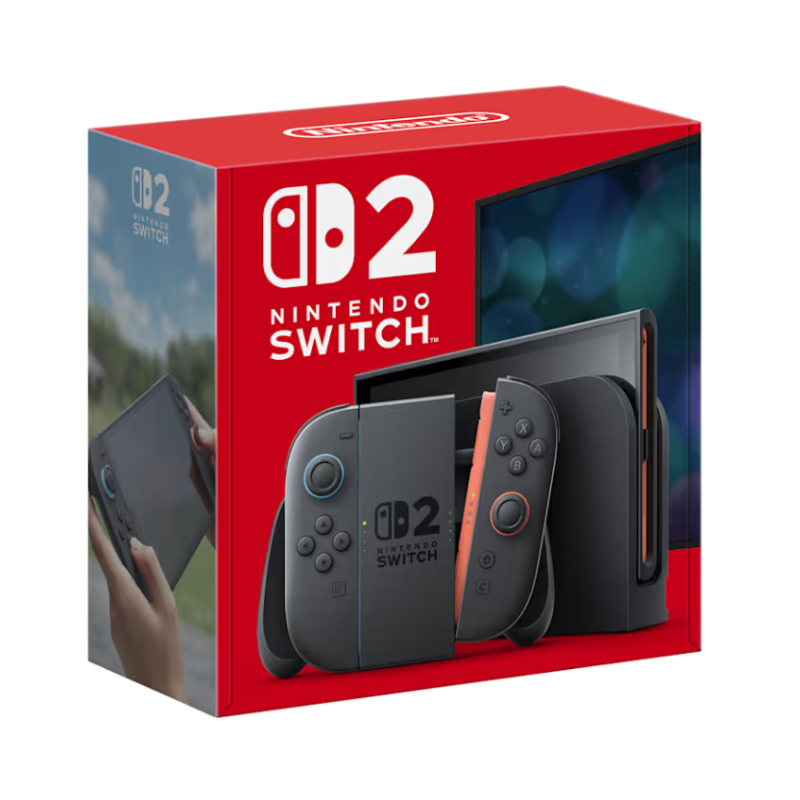
The Nintendo Switch 2 is Nintendo’s successor to the wildly successful Switch, released worldwide on June 5, 2025. It arrives as a more refined, powerful, and premium evolution of the hybrid console concept rather than a radical reinvention. While it launched alongside Mario Kart World as a flagship title, the console itself stands on its own merits as a significant hardware upgrade, offering a larger and sharper display, substantially improved internal components, and a redesigned controller system. This description focuses solely on the hardware, design, and ecosystem of the Switch 2, independent of any specific software bundle.https://sammertechnology.co.ke/
Design and Form Factor
The Switch 2 retains the familiar hybrid form factor of its predecessor—a tablet-like screen with detachable controllers on either side—but with several meaningful refinements. The console measures approximately 116mm x 272mm x 13.9mm with the Joy-Con 2 controllers attached, and it weighs around 401g for the tablet alone, or 534g with controllers attached . This makes it slightly larger and heavier than the original Switch, a trade-off for the significantly expanded screen and improved internals.
The most notable physical change is the magnetic attachment system for the new Joy-Con 2 controllers. Instead of the sliding rail mechanism of the original Switch, the Joy-Con 2 snap into place magnetically, secured by strong magnets that prevent wobbling or accidental detachment. A release button on the back of each controller allows for easy removal with one hand . This design has been widely praised as a substantial quality-of-life improvement, making the transition between handheld and docked modes far more seamless .
The console’s rear kickstand has also been upgraded to a hinged design that can open to a maximum of 150 degrees, allowing for adjustable viewing angles in tabletop mode. The stand is made from a lightweight yet sturdy aluminum alloy, providing a more stable foundation than the flimsy plastic stand of the original Switch . Additionally, a second USB-C port has been added to the top of the console, complementing the bottom port used for charging and docking. This top port can be used for charging during handheld play or for connecting accessories such as a USB camera for video calls .
Display and Visual Output
The Switch 2 features a 7.9-inch capacitive touchscreen LCD with a resolution of 1920×1080 (Full HD). Compared to the original Switch, the screen area is approximately 1.6 times larger, and the pixel count has doubled, resulting in a noticeably sharper and more detailed image . The display supports HDR10 and Variable Refresh Rate (VRR) up to 120Hz, a significant upgrade that brings smoother motion and more vibrant colors to handheld and tabletop play .
When docked to a television, the Switch 2 can output video at a maximum resolution of 3840×2160 (4K) at 60fps, a substantial leap over the original Switch’s 1080p TV output. At 1920×1080 or 2560×1440 resolutions, the console can output at up to 120fps, provided the connected display and the game support it . HDR10 is supported in TV mode as well. This expanded visual capability allows the Switch 2 to deliver experiences that are much closer to what players expect from contemporary home consoles, while still maintaining the flexibility of portable play.
Hardware and Performance
Under the hood, the Switch 2 is powered by a custom processor manufactured by NVIDIA, though Nintendo has not disclosed specific clock speeds or architecture details . The system includes 256GB of internal UFS storage, a significant increase over the original Switch’s 32GB, providing ample space for a modern digital library. A portion of this storage is reserved for system use, so the available space will be slightly less than the advertised figure .
For storage expansion, the Switch 2 uses microSD Express cards, a newer and faster standard than the standard microSD cards used by the original Switch. The console supports cards up to 2TB, though a system update via an internet connection is required before they can be used. Notably, standard microSD cards that are not Express-compatible can only be used to copy screenshots and videos, not to store or run games . This shift to a faster storage standard reflects the increased data demands of modern games and the console’s more capable hardware.
The Switch 2 supports Wi-Fi 6 for wireless connectivity and includes Bluetooth for accessories. In TV mode, a wired LAN connection is also possible via an adapter connected to the dock . The dock itself includes a built-in cooling fan, a new addition designed to help manage heat and maintain stable performance during extended docked play sessions .
Joy-Con 2 Controllers
The Joy-Con 2 controllers represent one of the most significant upgrades to the Switch 2 experience. Beyond the magnetic attachment system, the controllers feature larger analog sticks with improved accuracy, quieter operation, and greater durability . The L/R and SL/SR buttons have also been enlarged for more comfortable use.
A novel addition is the mouse sensor built into the side of each Joy-Con 2 that faces the console. When the controller is placed sensor-down and slid across a surface, it can function like a computer mouse. Both left and right Joy-Con 2 support this functionality, enabling new styles of play and even simultaneous two-handed mouse control . The controllers also retain HD Rumble 2 vibration and include NFC support for amiibo.
Each Joy-Con 2 contains an accelerometer and gyroscope for motion controls, and the controllers communicate wirelessly via Bluetooth . The controllers are charged when attached to the console, and the included Joy-Con grip allows them to be combined into a more traditional controller form for TV play.
Audio and Communication
The Switch 2 features stereo speakers with an independent enclosure structure that Nintendo claims provides natural, clear sound quality. A built-in monaural microphone is included, with noise cancellation, echo cancellation, and automatic gain control to improve voice chat experiences .
Audio output supports linear PCM 5.1ch when connected via HDMI in TV mode. A surround sound effect can be applied when using headphones or the built-in speakers, though the latter requires a system update. A standard 3.5mm headphone/microphone jack is provided for wired headsets .
Battery and Power
The console houses a 5220mAh lithium-ion battery, which Nintendo rates for approximately 2 to 6.5 hours of playtime, depending on the game and usage conditions. Charging via the included AC adapter takes around 3 hours while the console is in sleep mode .
In real-world testing, battery life has been a point of criticism. One reviewer measured approximately 4.5 hours of playtime while connected to Bluetooth headphones, playing games like Hades II and The Legend of Zelda: Tears of the Kingdom. While this falls within Nintendo’s stated range, it is comparable to or slightly worse than the original Switch and notably shorter than the OLED model . For players accustomed to longer portable sessions, a portable power bank may be a necessary accessory.
Power consumption in TV mode averages around 19W during active gaming, 8W on the HOME menu, and 0.5W in sleep mode with Wi-Fi connected .
Software and Backward Compatibility
The Switch 2 is backward compatible with the vast majority of Nintendo Switch games, both physical and digital. The game card slot accepts both Switch 2 and original Switch game cards . Many original Switch titles benefit from improved performance on the new hardware, and Nintendo has introduced a Handheld Mode Boost feature that treats Switch 1 games as if they are docked, resulting in resolution improvements when played in handheld mode .
The console’s eShop and online services are integrated into the existing Nintendo Switch Online ecosystem, and the console supports the new GameChat feature, which utilizes the built-in microphone for voice communication.
Market Position and Pricing
The Switch 2 launched at a price of **$449.99 in the United States**, a full $150 more than the original Switch’s launch price. In May 2026, Nintendo announced a price increase to $499.99, effective September 1, 2026, citing changes in market conditions. Similar increases were announced for Japan, Canada, and Europe .
This pricing places the Switch 2 in a more premium position than its predecessor, and it has drawn criticism alongside the rising cost of games. Mario Kart World, the console’s flagship launch title, was priced at **$79.99**, and other first-party titles have followed suit at $70 or higher . For budget-conscious buyers, the cumulative cost of the console, a game or two, and a microSD Express card for storage expansion represents a significant investment.
Despite these concerns, the Switch 2 has been a commercial success, becoming the second-fastest-selling console in US history and demonstrating strong demand for Nintendo’s unique hybrid proposition . A year after launch, reviewers have noted that the hardware itself is a meaningful improvement over the original, with the magnetic Joy-Con 2, improved display, and enhanced performance standing out as genuine upgrades. The primary criticisms center on battery life and the pace of first-party software releases, rather than the console’s design or capabilities .
Key Summary
-
Model: Nintendo Switch 2 (hybrid console)
-
Release Date: June 5, 2025
-
Display: 7.9″ LCD, 1920×1080, HDR10, VRR up to 120Hz
-
TV Output: Up to 4K @ 60fps; 1080p/1440p @ up to 120fps
-
Processor: Custom NVIDIA processor
-
Storage: 256GB UFS (expandable via microSD Express up to 2TB)
-
Controllers: Joy-Con 2 (magnetic attachment, mouse sensor, HD Rumble 2, larger sticks)
-
Battery: 5220mAh; 2–6.5 hours playtime; ~3 hours charging
-
Connectivity: Wi-Fi 6, Bluetooth, 2x USB-C, 3.5mm audio jack
-
Backward Compatibility: Yes — supports Switch game cards and digital titles
-
Dimensions/Weight: 116 x 272 x 13.9mm; 401g (tablet), 534g (with Joy-Con 2)
Based on 0 reviews
Be the first to review “NINTENDO SWITCH 2 without mario kart”
Related products
-
GAMING ACCESSORIES
PS5 SLIM GHOST OF YOTEI EDITION (WITH YOTEI CODE)
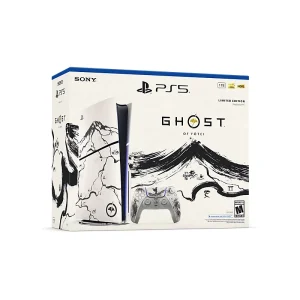
Category Specification Model PS5 Slim (CFI-2000 series) Edition Ghost of Yōtei Black Limited Edition (PlayStation Direct exclusive) Release Date October 2, 2025 Storage 1TB custom NVMe SSD Disc Drive Integrated Ultra HD Blu-ray drive Backward Compatibility Yes — majority of PS4 games supported Design Sumi-e black ink artwork of Mount Yōtei; maker’s seal etching Controller Custom themed DualSense (Atsu silhouette on touchpad) Included Game Digital voucher for Ghost of Yōtei + pre-order bonuses (mask + 7 avatars) — no disc Performance 4K up to 120fps, ray tracing, HDR, Tempest 3D AudioTech In the Box Console, DualSense, game voucher, HDMI cable, power cord, USB cable, horizontal stand feet, manual Not Included Vertical stand (sold separately) Pre-installed ASTRO’s Playroom Connectivity Wi-Fi 6, Bluetooth 5.1, Ethernet, USB-A/USB-C, HDMI 2.1 Power ~30% less consumption than original PS5 Availability PlayStation Direct exclusive; limited stock SKU: n/a -
GAMING ACCESSORIES
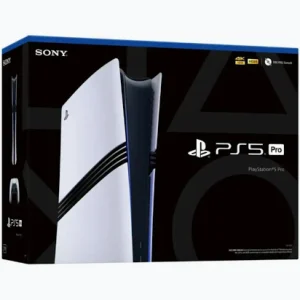
PS 5 PRO 2TB
Core Hardware
-
Model Number: CFI-7021
-
Storage: 2TB Custom NVMe SSD
-
Optical Drive: Not included (Digital-only console; disc drive sold separately)
-
GPU: Upgraded AMD RDNA-based GPU (67% more Compute Units, 28% faster memory)
-
Key Technologies: PlayStation Spectral Super Resolution (PSSR) AI upscaling, Advanced Ray Tracing
Performance & Display
-
Target Performance: 60fps, or up to 120fps with 4K output and Ray Tracing (on compatible games)
-
Max Output: Supports 8K output via HDMI 2.1
-
Connectivity: Wi-Fi 7 compatible, Ethernet, Bluetooth
Physical & Box Contents
-
Dimensions: Approx. 388 x 89 x 216 mm (H x W x D)
-
Weight: Approx. 3.1 kg
-
In the Box: PS5 Pro Console, DualSense Wireless Controller, 2 Horizontal Stand Feet, HDMI Cable, AC Power Cord, USB Cable, ASTRO’s PLAYROOM (Pre-installed)
SKU: n/a -
There are no reviews yet.