
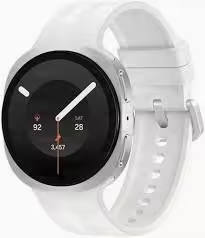
SAMSUNG GALAXY WATCH 9
| Category | Specification |
|---|---|
| Sizes & Weight | 40mm: 31.5g 44mm: 34g |
| Display | Panel: Sapphire Crystal Super AMOLED Peak Brightness: 3,000 nits Resolution: 438 x 438 (40mm); 480 x 480 (44mm) |
| Processor & Platform | Chip: Qualcomm Snapdragon Wear Elite (3nm) OS: Wear OS with One UI Watch Storage/RAM: 32GB / 2GB |
| Battery & Charging | Capacity: 390 mAh (40mm); 445 mAh (44mm) Rated Life: Up to 40 hours (AOD off); up to 30 hours (AOD on) Charging: Fast wireless charging |
| Durability | Water Resistance: 5 ATM + IP68 Certification: MIL-STD-810H |
| Connectivity | Wireless: Bluetooth 6.0, Wi-Fi 2.4/5GHz, NFC, GPS (dual-band) Cellular: Optional LTE |
| Health Sensors | Optical Heart Rate, Electrical Heart Signal (ECG), Bioelectrical Impedance (BIA), Skin Temperature, Blood Oxygen, Accelerometer, Gyroscope, Barometer |
| Key Software Features | Vitals, Energy Score, Daily Cardio Load, Fitness Index, Sleep Coaching, Running Coach |
| Colors | 40mm: Graphite, Cream 44mm: Graphite, Silver |
Price range: KSh 40,000.00 through KSh 42,000.00
The Samsung Galaxy Watch 9 represents Samsung’s 2026 refinement of its mainstream smartwatch formula, focusing on meaningful internal upgrades—a faster chip, a dramatically brighter display, and more sophisticated AI-driven health insights—while retaining the distinctive “squircle” cushion design that has defined recent Galaxy Watch models. Announced at Galaxy Unpacked in London on July 22, 2026, and released on August 7, the Watch 9 is positioned as a premium everyday companion rather than a rugged outdoor tool, leaving that territory to the more expensive Galaxy Watch Ultra 2 . It arrives in two sizes, 40mm and 44mm, with Bluetooth/Wi-Fi and LTE connectivity options, and in a curated palette of Graphite, Cream, and Silver .https://sammertechnology.co.ke/
Design and Display
The Galaxy Watch 9 maintains the lightweight aluminum casing and the softly rounded square shape that Samsung calls a “squircle,” a design intended to maximize screen real estate while remaining comfortable on the wrist. The 44mm variant measures 43.7 x 46.0 x 8.6mm and weighs just 34 grams, making it light enough for all-day and overnight wear without causing fatigue . The 40mm model is naturally more compact and is offered in Graphite and Cream, while the 44mm variant comes in Graphite and Silver, giving buyers a degree of stylistic differentiation between sizes . The watch carries a 5 ATM water resistance rating, making it suitable for swimming and exposure to rain, though it is not intended for high-velocity water sports or diving .
The most striking physical upgrade is the display. The Watch 9 features a sapphire crystal-covered sAMOLED panel with a resolution of 480 x 480 on the larger model and a peak brightness of 3,000 nits . This is a substantial leap over previous generations and addresses one of the most common complaints about smartwatches: legibility in direct sunlight. Reviewers who wore the watch in bright coastal and tropical conditions reported that text and on-screen elements remained clearly visible even under harsh sun, a meaningful practical improvement for outdoor runners, cyclists, and anyone who spends time outside . The always-on display (AOD) is supported, though enabling it has a predictable impact on battery life.
Performance and Platform
Under the hood, the Galaxy Watch 9 is powered by the Qualcomm Snapdragon Wear Elite platform, a 3nm chip that Samsung and Qualcomm positioned as a significant generational leap in wearable processing . The practical result, according to user reports and early reviews, is a watch that feels genuinely fast: app launches are snappy, animations are fluid, and navigating through menus and notifications no longer carries the occasional stutter that plagued earlier Wear OS devices . The operating system is Wear OS with Samsung’s One UI Watch overlay, which means users have access to the Google Play Store and a wide range of apps, alongside Samsung’s own ecosystem of services like Samsung Health, Samsung Wallet, and integration with Google Gemini for voice-activated assistance . The watch also includes a software update commitment extending to July 2031, which is a notably long support window for a wearable and a point in its favor for buyers planning to keep the device for several years .
Health and Fitness Tracking
Samsung has increasingly leaned into AI-assisted wellness features, and the Watch 9 is the clearest expression of that strategy yet. The watch’s BioActive sensor array includes optical heart rate, electrical heart signal (for ECG), bioelectrical impedance analysis (BIA) for body composition, skin temperature, and a suite of motion sensors including accelerometer, gyroscope, and barometer . On top of this hardware, Samsung has layered a set of features designed to translate raw data into actionable guidance.
The “Vitals” dashboard is a centralized view that displays heart rate, heart rate variability, temperature, and breathing rate together, giving users a quick snapshot of their physiological state . The “Energy Score” is a calculated readiness metric derived from sleep time, BMI, vascular load, and moderate-to-vigorous activity time, intended to help users decide whether to push hard in a workout or prioritize recovery . “Daily Cardio Load” tracks accumulated cardiovascular strain and recommends training targets and rest periods, requiring at least seven days of activity records for baseline accuracy and recommending 28 days of continuous wear for optimal results . For runners, the “Running Coach” feature provides real-time pace guidance and feedback during workouts, requiring the Samsung Health app version 6.30 or above .
Sleep tracking remains a central pillar, with the Watch 9 offering detailed sleep stage analysis and “Sleep Coaching” that provides personalized recommendations based on recorded patterns. The watch requires at least seven nights of sleep data to generate meaningful insights . The BIA sensor enables body composition measurements—body fat percentage, skeletal muscle mass, and body water—though Samsung is careful to note that these features are intended for general wellness and fitness purposes only, not for medical diagnosis or treatment . The ECG function is available for users to record heart rhythms, and blood pressure monitoring is supported in certain markets where regulatory approval has been granted. A “Fitness Index” feature compares heart rate, VO2 max, and daily step data against peers to identify strengths and weaknesses and suggest tailored goals . Samsung has also added an “Antioxidant Index” that estimates carotenoid levels in the skin using the BioActive sensor, framed as a prompt to pay attention to fruit and vegetable intake rather than a clinical nutritional assessment . It is important to emphasize that all of these features sit firmly in the wellness category; none are cleared medical devices, and Samsung’s own documentation repeatedly states that the data is for fitness and wellness purposes only .
Battery Life and Charging
Battery life is the most contentious aspect of the Galaxy Watch 9. The 40mm model carries a 390 mAh cell, while the 44mm model has a 445 mAh battery . Samsung’s official estimates are up to 40 hours of usage with the always-on display disabled and up to 30 hours with AOD enabled . In practice, user reports vary considerably. Some users describe getting through a full day with 30% remaining, while others report struggling to exceed a single day, particularly with LTE active or with heavy health tracking . A few users report achieving two days or slightly more with lighter usage and AOD off . The honest assessment is that the Watch 9 is a daily-charge device for most users, and those accustomed to the multi-day battery life of some Garmin or Huawei watches will find it a compromise. Charging is relatively quick, with some users noting that a half-hour top-up before bed and another in the morning is sufficient to keep the watch running through a 24-hour cycle .
Connectivity and Everyday Use
The Watch 9 supports Bluetooth 5.x, Wi-Fi, NFC for Samsung Wallet payments, and optional LTE for untethered calling and messaging. The LTE variant allows users to leave their phone behind for runs or errands while remaining reachable, though this naturally accelerates battery drain. The watch integrates deeply with Samsung Galaxy phones, offering seamless notification mirroring, call handling, and app continuity, but it also works with Android phones running Android 13 or above, provided the Samsung Health app (version 7.0 or above) is installed and a Samsung account is used . The Google Gemini integration enables voice-activated queries and actions, and users have reported finding it useful for quick information lookups while driving or when their hands are occupied . The watch faces are customizable, and Samsung offers a range of first-party and third-party options through the Play Store.
Pricing and Positioning
At launch, the Galaxy Watch 9 starts at $379.99 for the 40mm Bluetooth model in the United States, rising to $409.99 for the 44mm Bluetooth variant, $429.99 for the 40mm LTE, and $459.99 for the 44mm LTE . In the United Kingdom, pricing starts at £349 for the 40mm and £379 for the 44mm . In India, the 40mm model launched at ₹38,999, with the 44mm at ₹42,999 and LTE variants commanding a premium . This places the Watch 9 in direct competition with the Apple Watch Series 11 (or its contemporary equivalent) and the higher end of the Android Wear ecosystem. It is more expensive than previous base-model Galaxy Watches—the Watch 9 saw a roughly $30/£30 increase over its predecessor—but Samsung justifies this with the new chip, the brighter display, and the expanded AI health suite .
Verdict
The Samsung Galaxy Watch 9 is a polished, capable smartwatch that excels at the fundamentals: it is fast, comfortable, bright enough to use anywhere, and deeply integrated into both the Samsung and broader Android ecosystems. Its health features are expansive and increasingly intelligent, though users should understand that they are wellness tools rather than medical instruments. The primary compromise is battery life, which for most users will mean a daily charging routine. For Android users—particularly those already within Samsung’s Galaxy ecosystem—who want a responsive, feature-rich smartwatch with excellent outdoor visibility and sophisticated sleep and activity tracking, the Watch 9 is a compelling choice. Those who prioritize multi-day battery life or rugged durability should look elsewhere, either to Samsung’s own Watch Ultra 2 or to competitors like Garmin. The Watch 9 is not a radical reinvention, but it is a confident refinement of a formula that Samsung has been honing for years, and for the right user, it is one of the best all-around Android smartwatches available in 2026.
| WATCH 9 | 40 mm, 44 mm |
|---|
Based on 0 reviews
Be the first to review “SAMSUNG GALAXY WATCH 9”
Related products
-
Accesories
M185 MOUSE
Overview
The Logitech M185 is a compact and reliable wireless mouse designed for ease of use and portability. It features plug-and-play functionality, making it compatible with Windows, Mac, and Linux systems.Design
This mouse has a comfortable, contoured shape that fits well in either hand, providing more comfort than a touchpad. Its compact design allows for easy storage alongside laptops or netbooks.Connectivity
Utilizing Logitech’s advanced 2.4 GHz wireless technology, the M185 offers a stable connection with minimal delays or dropouts. The tiny USB receiver can be plugged into a port and left there without worry of losing it.Battery Life
The M185 boasts an impressive battery life of up to one year on a single AA battery. Features like an On/Off switch and smart sleep mode help conserve power.Warranty and Reliability
Logitech provides a three-year limited hardware warranty with this mouse, ensuring its durability and reliability over time.KSH 2500
SKU: n/a -
Accesories
ORAIMO TYPE C-C CABLE
- length 1.5 m
- flat cable
- connector one: type c/connector two: type c
- cable speed: 800 mbps (high speed syncing)
- lightspeed data transfer: don’t wait for sync or transfer any more. an up to 800mbps transmission rate means you can transfer shows, movies, and music in a matter of seconds.
- reinforced connector: the connector is reinforced with sr material to make it more durable and withstand thousands of stretches and bends.
KSH 500
SKU: n/a


There are no reviews yet.