
GOOGLE
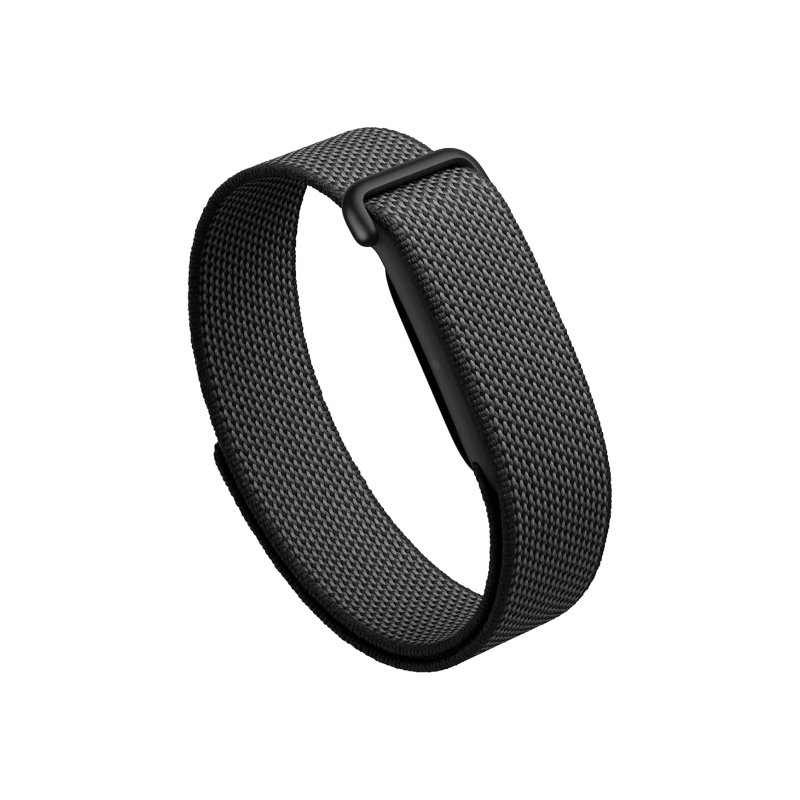
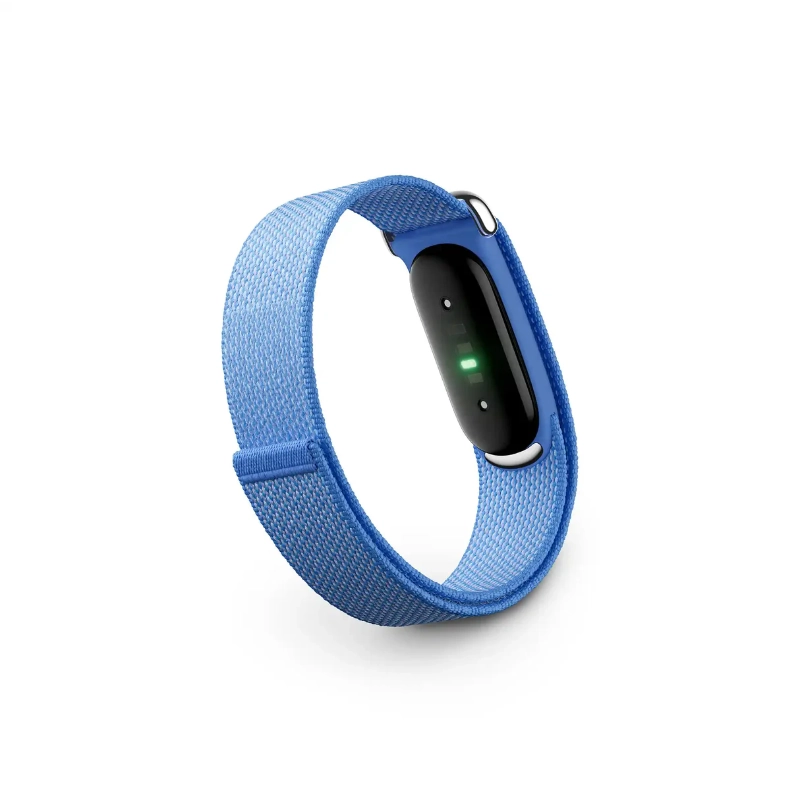
Google Fitbit air
| Category | Specification | Details |
|---|---|---|
| Design & Build | Form Factor | Screenless “pebble” style tracker with no display or buttons |
| Dimensions | 34.9 mm (L) x 17 mm (W) x 8.3 mm (H) | |
| Weight | 5.2 g (tracker only) / 12 g (with band) | |
| Materials | Recycled polycarbonate/PBT housing; textile band with stainless steel buckle | |
| Water Resistance | Up to 50 meters (5 ATM) | |
| Sensors & Tracking | Sensors | Optical heart rate monitor, 3-axis accelerometer + gyroscope, SpO2 (red/infrared) sensors, skin temperature sensor |
| Health Metrics | 24/7 heart rate, HRV, resting heart rate, sleep stages, SpO2, skin temperature variation, and Afib alerts | |
| Activity | Automatic workout detection, guided workouts via app | |
| Battery & Charging | Battery Life | Up to 7 days |
| Charge Time | 90 minutes (0-100%) | |
| Fast Charging | 5 minutes provides up to 1 day of use | |
| Connectivity & Compatibility | Wireless | Bluetooth 5.0 (LE) |
| Sync Range | Up to 30 ft (approx. 9 m) | |
| App | Requires Google Health app | |
| OS Support | Android 11.0+ / iOS 16.4+ |
KSh 21,000.00
Related products
-
GOOGLE
GOOGLE Pixel watch 4 41mm wifi
Category Specification Design & Build Dimensions 41 mm diameter × 12.3 mm height Weight 31.0 g (without band) Materials 100% recycled aluminum case; fluoroelastomer Active Band Water Resistance 5 ATM / up to 50 meters Repairability User-replaceable battery and display (first for Pixel Watch) Display Type Actua 360 AMOLED LTPO, 320 PPI, DCI-P3 Glass Custom 3D Corning Gorilla Glass 5 Brightness Up to 3,000 nits peak; 1 nit minimum (AOD) Refresh Rate 1–60 Hz adaptive Performance Chip Qualcomm Snapdragon W5 Gen 2 + Cortex-M55 co-processor RAM / Storage 2 GB SDRAM / 32 GB eMMC flash OS Wear OS 6.0 Battery & Charging Capacity 325 mAh Battery Life Up to 30 hours (AOD on); up to 48 hours (Battery Saver) Charging 15 min → 50%; 25 min → 80%; 45 min → 100% Sensors & Health Key Sensors Multi-path optical HR, ECG (multi-purpose electrical), SpO2 (red/IR), skin temperature, cEDA, barometer, altimeter, compass, gyroscope, accelerometer Health Features 24/7 HR, HRV, sleep stages (18% more accurate), ECG/AFib, Loss of Pulse Detection, Car Crash Detection Connectivity Wireless Wi-Fi (802.11 a/b/g/n/ac/ax), Bluetooth 6.0, NFC, dual-frequency GPS (L1+L5) Compatibility Android 11.0+ (requires Google Account & Pixel Watch app) In the Box Watch (41mm), S & L Active Bands, Fast Charging Dock, Quick Start Guide SKU: n/a -
GOOGLE
GOOGLE PIXEL 8 PRO
Feature Category Specification Display 6.7-inch LTPO OLED (“Super Actua”)
Resolution: 1344 x 2992 pixels (QHD+)
Refresh Rate: Adaptive 1-120Hz
Peak Brightness: 2400 nitsProcessor Google Tensor G3 chipset (4nm) Memory & Storage 12GB RAM (LPDDR5X)
Storage: 128GB / 256GB / 512GB / 1TB (UFS 3.1)Camera System Rear (Triple):
• 50MP Wide (main, OIS)
• 48MP Ultra-Wide (125.5°)
• 48MP Telephoto (5x optical zoom, OIS)
Front: 10.5MP Ultra-Wide (with autofocus)Battery & Charging 5050 mAh battery
Charging: 30W wired, 23W wirelessSoftware Launched with Android 14
7 years of OS and security updatesDurability & Design IP68 dust/water resistant
Glass front/back (Gorilla Glass Victus 2), aluminum frame
Colors: Obsidian, Porcelain, Bay, MintOther Features Temperature sensor, Ultra-Wideband (UWB), Titan M2 security chip, Face Unlock (high security), under-display fingerprint SKU: n/a -
GOOGLE
GOOGLE PIXEL 8
Category Specification Display 6.2-inch OLED, 1080×2400 FHD+, 120Hz refresh rate, 2000 nits peak brightness Processor Google Tensor G3 (4nm, Nona-core: 1×3.0 GHz + 4×2.45 GHz + 4×2.15 GHz) RAM 8GB LPDDR5X Storage 128GB / 256GB UFS 3.1 (non-expandable) Rear Camera 50MP primary (f/1.68) + 12MP ultra-wide (f/2.2) Front Camera 10.5MP ultra-wide (f/2.2) Battery 4,575 mAh, 27W wired, 18W wireless, reverse wireless charging Connectivity 5G, Wi-Fi 7, Bluetooth 5.3, NFC, USB-C 3.2 Build Gorilla Glass Victus front/back, IP68 water/dust resistance OS Android 14, 7 years of updates Dimensions 150.5 x 70.8 x 8.9 mm, 187g Colors Hazel, Obsidian, Rose SKU: n/a -
GOOGLE
GOOGLE PIXEL 10 PRO XL
Category Specification Display 6.8-inch LTPO OLED, 1-120Hz refresh rate, 1344 x 2992 resolution, 3300 nits peak brightness . Platform Google Tensor G5 chip (3nm), Android 16, 7 years of OS/security updates . Memory & Storage 16GB RAM; Storage options: 256GB, 512GB, or 1TB UFS 4.0 . Rear Camera Triple System: 50 MP Wide (ƒ/1.68), 48 MP Ultrawide (ƒ/1.7), 48 MP Telephoto (ƒ/2.8) with 5x optical zoom. Features: Pro Res Zoom up to 100x, OIS, 8K video . Front Camera 42 MP ultrawide with autofocus . Battery & Charging 5200 mAh, 45W wired charging (70% in 30 min), 25W Qi2 wireless magnetic charging (Pixelsnap) . Design IP68 water/dust resistant. Colors: Obsidian, Porcelain, Moonstone, Jade. Dimensions: 162.8 x 76.6 x 8.5 mm. Weight: 232g . Key Features Built-in Gemini AI (Live, Nano), AI Mode, advanced photo editing, Magic Cue, satellite SOS, ultrasonic fingerprint sensor ksh 100,000-125,000
SKU: n/a


There are no reviews yet.